Saturday, September 8, 2018

Shrunken Dimension - Very useful for higher level summary

Shrunken Dimension is a very special type of dimension when there is a requirement of higher level of summary and lower grain data is already available in the warehouse.

Before we dive in if you do not understand what is the grain of the dimension, it is important to understand.

Month could be a shrunken dimension of date,  which could be connected to a fact which has grain of month like monthly sales. But this is a very classic example, let us deep dive a little with another example.
Considering the Online Movie Ticketing business scenario, we would have 2 tables, a fact for Ticket sales and a related dimension of the Venue for which sold the ticket. 
If customer need to view the total consolidated Sales at city level rather than Venue level, we could create a separate dimension for City and a separate fact table for Consolidated Sales. The image below demonstrates the same:
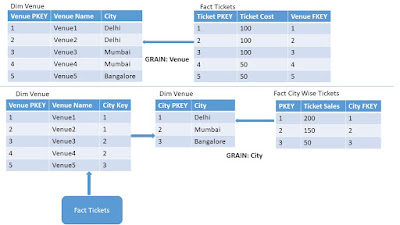
Shrunken Dimension Example

In the example above we have created a base dimension and Shrunken dimension separately. If needed we could also create the Shrunken dimension from the base dimension, once it is loaded. Again it totally depends on the business requirements and the type of source system you are dealing with.

Static Dimension in Datawarehouse

Static Dimension are not extracted from the data source, but created in warehouse itself in the context of warehouse. These are usually loaded just once, manually or by the help of a procedure. The data of this dimension does not change or changed very rarely.

A few common examples of the static dimensions would be "DIM_SOURCE_SYSTEMS", "DIM_STATUS_CODE" or date time as well.

Please do not confuse it with the SCD Type 0. In SCD type 0, we insert data regularly but never update it. Also, they are loaded with the data extracted from source.

Click here to read about the other dimensions in datawarehousing.

Sunday, September 2, 2018

Microsoft Teams is now Free - Can it be the Game Changer

Microsoft Teams is a platform that combines workplace chat, meetings, notes, and attachments. The service integrates with the company's Office 365 subscription office productivity suite, including Microsoft Office and Skype, and features extensions that can integrate with non-Microsoft products.

Microsoft initially released in 2017, but recently Microsoft announced a free version of it, which could be very useful for new startups or educational groups which want to collaborate for free with lots of features.

So what does the free version of Microsoft teams allows you to do:
  • Add up to 300 members to collaborate with 2GB free space per user.
  • 10 GB shared storage
  • Unlimited messaging and search.
  • Secure File Sharing
  • One on one Meetings with audio and video facilities.
  • Channel Meetings for Multiple People in team
  • Screen Sharing
  • MS word, PowerPoint, excel and One Note
  • Access to 140+ other apps and services
  • All this is available over cloud, which means it is not device specific. Just login with your account and you got all you work saved using other machines.

Sunday, August 19, 2018

What is Inferred dimension and Why it is important

Inferred Dimension, also referred to as Early coming Fact or Late coming dimension. These all are different names of same scenario.

If the source systems of your Data warehouse are very well designed, you should never face this scenario. But, sometimes it would happen that the fact data is available in the source but related dimension data does not yet exists.

Consider that Online Movie Ticketing business scenario. Suppose a sales person sold some bulk movie tickets to an organisation at some discount. He provided a discount with a new promotion code, which he is supposed to punch in the system but forgot. When the ETL would process the data it will find that the promo code is not available.

There are 2 ways to handle this scenario:

  • 1st one is to mark the FKey as unknown. This is the simplest option but these sales records could not be used for the reporting purpose unless the dimension record arises or the fact is updated accordingly. Which is an ETL overhead altogether.
  • The other option is to use Inferred Dimension. For any such record we could create an entry in the dimension table and mark it inferred as shown in the image below.
Inferred Dimension
Using this method, our fact record could be used for reporting and a better picture would be generated. At a later load when the promo code details would be available, the dimension record could be updated automatically, depending on what type of Slowly Changing Dimension it is.

Sunday, August 12, 2018

OLTP vs OLAP explained

Both OLAP and OLTP are databases are designed for different purposes.

OLTP stands for Online Transaction Processing and is optimized for insert. update and delete operations. This is the reason these are used behind the application for regular business transactions.

OLAP stands for Online Analysis Processing and this databases are optimized for read operation and are widely used for analyzing, mining and reporting on large datasets.

It is important to note here that the database in which we store all the Facts and Dimensions is also OLTP. Post this we move the data to create a cube, which is stored in a OLAP database.

The image below explains the major differences of a OLTP and OLAP systems.
Now that we know the basic difference between OLTP and OLAP, lets now dig a little deeper.

  • The core of any OLAP system is a Cube, which is just a three-dimensional spreadsheet, where as in OLTP data is stored in 2D tables.
  • A cube consists of Numeric Facts called measures and are categorized by dimension data.
  • The metadata of any cube is star schema or Snowflake Schema or Fact Constellation in relational(OLTP) database. Measures are derived from the records in the fact table and dimensions are derived from dimension tables.
  •  While we can perform CRUD operation in OLTP, there are a few more operations which we could perform on a cube. These include Slicing, Dicing. Pivoting etc.
If you liked the post, please share it.
Subscribe to your email and receive new articles on your email